
The Court of International Trade Certifies an IEEPA Refund Class: What the Freestyle World Ruling Means for Importers With Outstanding Refunds
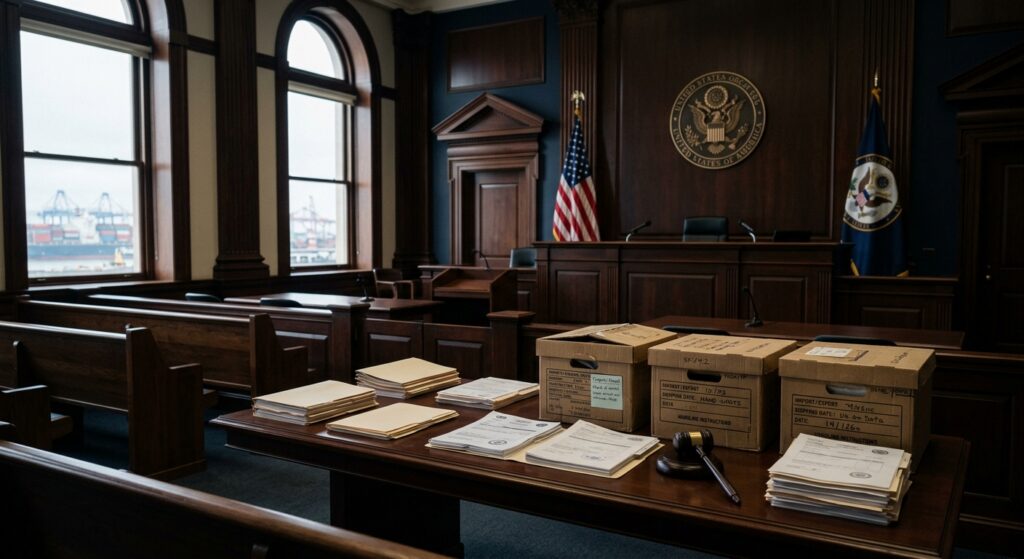
A photorealistic editorial image of a dim, formal federal courtroom interior shown from the back benches toward an empty judge's bench, warm wood paneling, tall American flag beside the bench, soft directional light streaming through tall windows onto neat stacks of shipping and customs paperwork, cardboard import boxes, and manila folders arranged on a long polished table in the foreground, a gavel resting beside the documents, subtle motif of international cargo ships or shipping containers faintly visible through a window in the background, muted navy, gold, and mahogany color palette, serious and institutional mood, shallow depth of field, high-detail professional photography style, no text or logos visible anywhere in the frame.

The Court of International Trade certified a nationwide class of importers who paid unlawful IEEPA tariffs, but no refund injunction has issued yet. This article explains the class definition, key exclusions like Brazil and India tariffs, interaction with CBP’s CAPE system, and whether importers should rely on the class or file individual claims before 2027 deadlines.

Read More

CAPE Phase 3 Opens Oct. 6: IEEPA Refunds on Final Entries for CIT Plaintiffs

A photorealistic editorial illustration of a U.S. Customs and Border Protection processing environment, rendered in a cool corporate blue and steel-gray palette. In the foreground, a large courthouse column and set of classical steps rise beside a modern digital control interface, symbolizing the intersection of litigation and automated customs processing. Overlaid on the scene, translucent holographic panels display abstract shipping manifests, stacked cargo containers, and a glowing calendar highlighting a date circled in red, suggesting an official regulatory deadline. In the background, a soft-focus shipping port with cranes and stacked containers fades into a hazy horizon, while streams of light representing data flow between the courthouse and a digital ledger of financial transactions. A gavel rests subtly beside a stylized customs seal, and faint binary-like light trails connect scattered padlock icons—some open, some closed—representing selective, restricted access to a bureaucratic refund system. The mood is precise, institutional, and quietly tense, reflecting complex trade law and regulatory gatekeeping. Use a realistic, high-detail editorial illustration style with dramatic directional lighting, sharp shadows, and a restrained, professional color palette of navy, slate, silver, and muted gold accents. No text, logos, or captions anywhere in the image.

U.S. Customs and Border Protection has informed the Court of International Trade that Phase 3 of its CAPE refund system will launch October 6, 2026, enabling reliquidation of finally liquidated entries subject to IEEPA duties. Unlike prior phases, Phase 3 is restricted to importers who are plaintiffs in IEEPA refund litigation and whose entries are…

Read More